| Postcolonialism examines the effects of colonization on both colonized and colonizer societies, focusing on issues like identity, power, dynamics, race, and resistance. The short story « The thing around your neck » from the Nigerian Chimamanda Ngozi Adichie shows the consequences of imperialism. |  |
Setting
The story takes place primarily in Connecticut, America. But at the beginning the story starts in Lagos in Nigeria and then temporarily in Maine in America. It’s not clear in which year the story takes place. The first American visa lottery was 1995 and the story was published in 2009. The time period of the action is in the early 2000s.
Plot
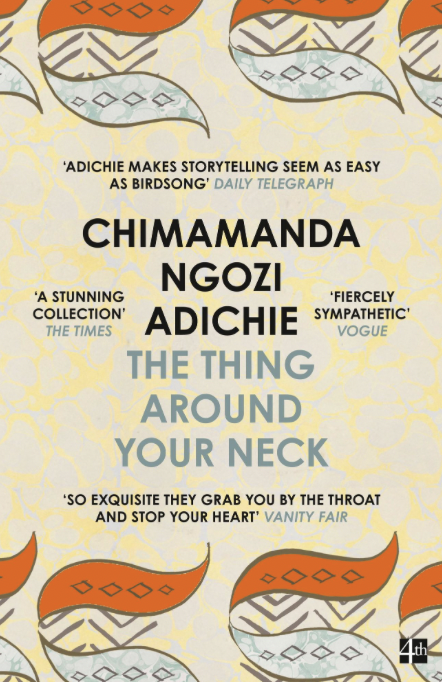 | Akunna, a girl in her twenties from Lagos, Nigeria, won the American visa lottery and moved to the U.S. Her family expected wealth and guns in America. Living with her uncle’s family in Maine, she faced stereotypes and discomfort. Her uncle’s advances prompted her to flee to Connecticut, where she struggled to afford college and worked in a restaurant to send money home. She felt invisible and choked by the weight of her new life. She fell in love with an American who she initially despised, and they had a relationship, marked by misunderstandings and cultural clashes. Despite the resistance, their bond grew until she no longer felt understood by him. When Akunna found out about her father’s death, shedecided to return to Lagos alone, leaving behind her American life. |
Consequences of Imperialism
These consequences of the colonial period are discussed in the story.
American Visa Lottery and unequal opportunities
The American Visa Lottery is exactly what it sounds like. Even today, 55’000 green cards are raffled off every year at Green Card Lottery. The goal is to preserve the cultural diversity of the USA. The conditions for participation are the country of birth and the level of education.
Akunna takes part in the American Visa Lottery because it gives her a better chance of getting a good education in the USA. This is shown by the backwardness of post-colonized Nigeria. During the colonial period, Britain did not set up schools in the northern Nigeria so that they would be inferior to them. The Igbo, the tribe of Akunna, also remained behind during this time.
“You did not know that people could simply choose not to go to school, that people could dictate to life.” This passage shows, in Africa, if they are lucky, children go to school and then they do the same thing as their parents did. There’s no choice like in America.
Financial Struggles
Akunna’s family is poor, and Akunna sends them her wages every month. The poverty of her family and her friends in Nigeria is also a consequence of imperialism. Due to its economic dependence on oil and other countries, Nigeria is poor despite its rich natural resources.
Sexual exploitation
The sexual exploitation by her “uncle” in the USA shows the ongoing patriarchal structures, which were often reinforced by colonial power relations. This is particularly evident in this passage: “If you let him, he would do many things for you. Smart women did it all the time. How did you think those women back home in Lagos with well-paying jobs made it?” Akunna’s uncle’s horrifying behavior adds a grim perspective to his statement about American “give and take.” He expects her to give up her autonomy to maintain the relatively comfortable life she has at his home. The idea that women must gain economic advantage through sexual favors is linked to colonial exploitation and abuse.
The feeling of loneliness
Colonialism left psychological scars on many of those affected, including a deep-seated feeling of inferiority or insecurity in new westernized environments. Akunna’s loneliness can also be seen because of the confrontation with another culture and the question of one’s own identity. Even though she has a boyfriend, she still feels lonely sometimes because her different culture always leads to conflicts.
One day Akunna told her boyfriend that her father was not a schoolteacher in Lagos but a driver for a construction company. She told the story of when her father drove into the car in front of him because of the rain. It was a foreign car and her father started crying and begging for mercy. This also shows her father’s feeling of inferiority compared to foreigners.
Racism
In addition, imperialism also spread racism. She was treated like an animal, the girls at her school touched her hair because it was exotic to them. All immigrants are put in the same box. For example, the manager of the restaurant, where Akunna works, also said that all immigrants work hard and that’s why he hires them. The society judged Akunna’s boyfriend for dating a black woman. Many people were convinced that humanity would lose quality if different “races” mixed.